

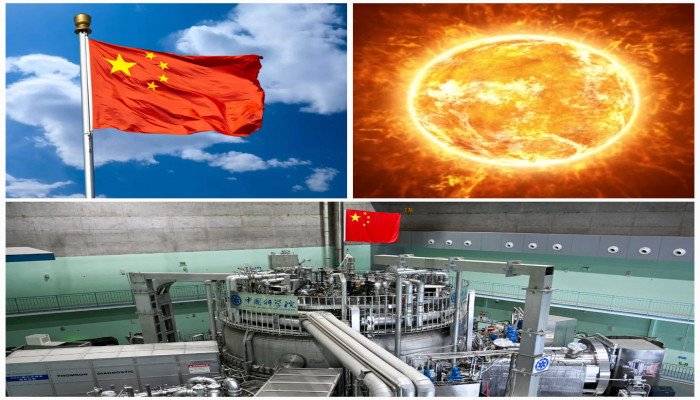

Surpassing previous milestones, this marks a major leap in fusion energy development.
China has made a historic breakthrough in its pursuit of clean energy, achieving a groundbreaking milestone in nuclear fusion research. The Experimental Advanced Superconducting Tokamak (EAST), often referred to as China’s “artificial sun,” successfully maintained plasma for a record 1,000 seconds, or more than 17 minutes.
This achievement surpasses the previous record of 403 seconds set in 2023, marking a significant step forward in the development of fusion energy.
Nuclear fusion, the process that powers the sun, has long been considered the “holy grail” of energy production. Unlike nuclear fission, which splits atoms, fusion involves the merging of atomic nuclei to release immense amounts of energy, with no greenhouse gas emissions and a much lower risk of accidents. However, creating the right conditions to sustain fusion reactions at temperatures exceeding 100 million degrees Celsius has proven to be a major scientific challenge. By stabilizing the plasma for over 17 minutes, Chinese researchers believe they have reached a crucial milestone in advancing fusion technology.
Song Yuntao, director of the Institute of Plasma Physics at the Chinese Academy of Sciences, emphasized the importance of this achievement. He explained that for fusion to be viable as an energy source, a device must operate stably at high efficiency for extended periods, enabling the self-sustaining circulation of plasma—a key requirement for continuous power generation. He also expressed hopes for greater international collaboration in the ongoing quest for practical fusion energy solutions.
While the EAST reactor has not yet reached “ignition”—the point at which fusion creates its own energy and sustains the reaction—this record provides strong evidence of progress in maintaining stable and confined plasma loops, a critical factor for the development of future fusion reactors.
Since its operation began in 2006, EAST has undergone a series of tests, with this latest achievement providing renewed optimism about the potential of fusion energy. China is also building new experimental fusion research facilities in Anhui Province to further advance the technology.
The promise of nuclear fusion as an unlimited, clean energy source has sparked global interest. If perfected, it could address the world’s energy crisis, reduce reliance on fossil fuels, and potentially power humanity’s exploration beyond our solar system.
Scientists and engineers remain hopeful that fusion energy will play a pivotal role in shaping the future of global energy production.
