

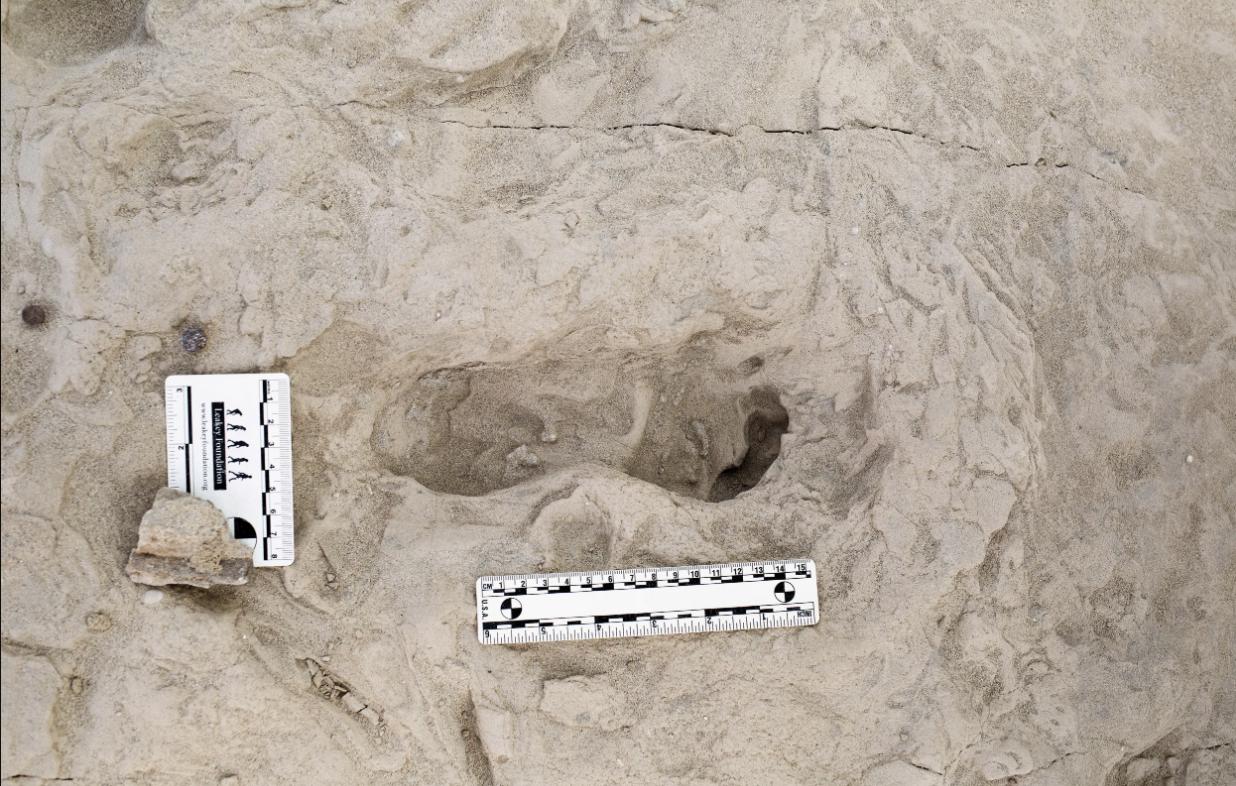

Fossilized footprints unearthed in northern Kenya provide fascinating evidence of interaction between two ancient human species 1.5 million years ago.
Discovered at Koobi Fora near Lake Turkana, the tracks reveal that Paranthropus boisei and Homo erectus coexisted in the same habitat, shedding light on their evolutionary relationship.
The site contains 12 footprints linked to Paranthropus boisei and three belonging to Homo erectus. These impressions were likely made within hours or days of one another, indicating that the two species may have crossed paths along the lakeshore.
“These footprints capture a moment in time, offering a vivid glimpse of life 1.5 million years ago,” said Louise Leakey, director of the Koobi Fora Research Project. “These early humans likely encountered each other while foraging or wading in shallow waters.”
Standing up to 4 feet 6 inches tall, Paranthropus boisei had a robust build and large molars for chewing tough plants. Their flat-footed gait was closer to that of chimpanzees. In contrast, Homo erectus, measuring between 4 feet 9 inches and 6 feet 1 inch, had a more advanced, modern-like walking style.
The findings confirm that the two species coexisted in the region for over 200,000 years. Differences in their diets—Paranthropus boisei favoring tough plant material and Homo erectus having an omnivorous diet including meat—likely reduced competition for resources.
“These footprints reveal behaviors and interactions that skeletal remains and tools cannot,” noted Neil Roach from Harvard University.
Although Paranthropus boisei eventually went extinct, Homo erectus flourished, becoming the first human species to migrate out of Africa.
Published in Science, the research also highlights the risks and rewards of this resource-rich lakeshore, teeming with predators such as crocodiles and hippos.
“This discovery is crucial for understanding the shared landscapes and dynamics of ancient human ecosystems,” said lead author Kevin Hatala of Chatham University.
