

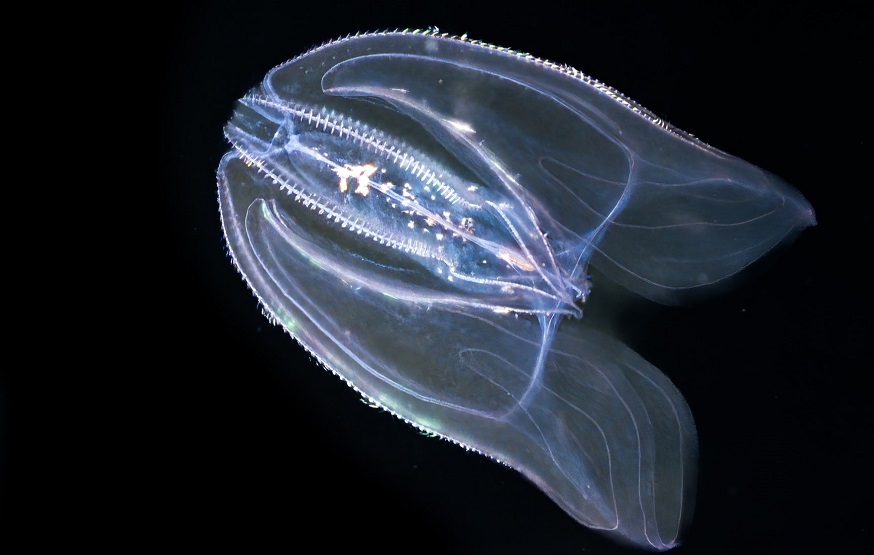

Researchers at the University of Bergen in Norway have made a groundbreaking discovery: the comb jellyfish (Mnemiopsis leidyi), a species of ctenophore, might possess a unique biological trait for potential immortality.
According to a report by the New York Post, the comb jellyfish now joins the ranks of the “immortal jellyfish” (Turritopsis dohrnii) due to its recently uncovered ability. While examining these creatures, scientists encountered an unexpected discovery—a larval ctenophore in a tank that was supposed to contain a mature jellyfish.
Published in the Proceedings of the National Academy of Sciences, this finding raises intriguing questions about the potential of other species to reverse aging. “This work challenges our understanding of early animal development and body plans, opening new avenues for studying life cycle plasticity and rejuvenation,” said Joan J. Soto-Angel, a study co-author, as quoted by Phys.org.
Soto-Angel added that discovering a new species with this “time-travel machine” for reversing aging opens exciting questions about how widespread this trait might be in the animal kingdom.
Her team ran experiments attempting to recreate the conditions that triggered the comb jellyfish to revert to its larval stage, identifying extreme stress as the key factor. Previous studies suggest that comb jellyfish may have been among the first animals to appear on Earth around 700 million years ago, with their longevity possibly tied to this ability to reverse development.
“This is a very exciting time for us,” said Paul Burkhardt, another co-author. “This finding could lead to many important discoveries, including insights into the molecular mechanism driving reverse development and what happens to the animal’s nerve net during this process.”
Such discoveries may one day help scientists understand how humans might tap into the aging process as well.
