

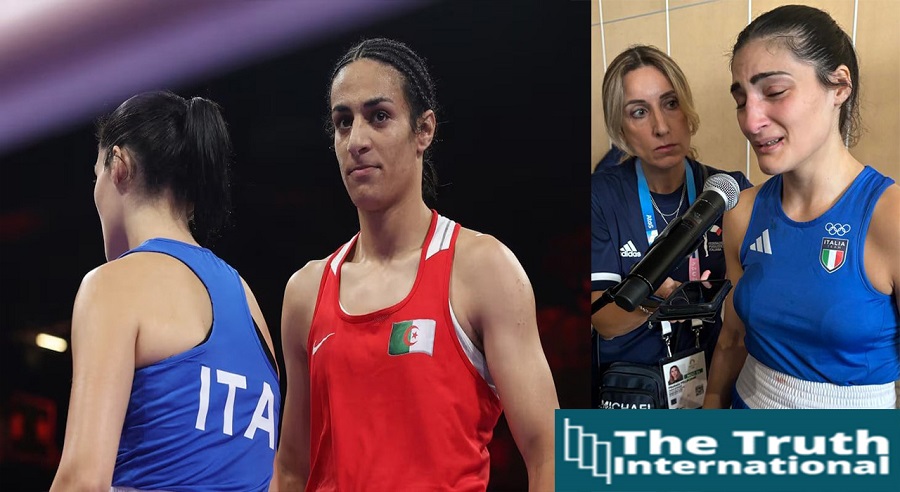

Italian boxer Angela Carini withdrew from the Paris Olympics on Thursday after enduring a series of powerful blows from her Algerian opponent, Imane Khelif. Khelif, who had previously failed a gender eligibility test at the World Championships, was allowed to compete in the Games by the International Olympic Committee (IOC), a decision that sparked controversy among boxers.
In the first 30 seconds of their bout, Khelif landed several punches, including a decisive right hook to Carini’s nose. This prompted the Italian to raise her hand and retreat to her corner, signaling her intent to withdraw.
Her coach confirmed the decision, ending the women’s welterweight round of 16 match. A distraught Carini fell to her knees in the ring, sobbing and refusing to shake Khelif’s hand after the referee declared the Algerian the winner.
“I am a fighter. My father taught me to be a warrior. When I am in the ring, I have the mindset of a warrior, a winning mindset,” Carini told reporters after the match. “This time, I couldn’t make it.”
Reflecting on her decision to surrender, Carini added, “I didn’t lose tonight; I just surrendered with maturity.”
The match took place at the North Paris Arena in Villepinte, France, on August 1, 2024.
Imane Khelif and Taiwan’s double world champion, Lin Yu-ting, were both cleared to compete in Paris after the IOC assumed control of the 2024 boxing competition, following the International Boxing Association’s (IBA) loss of status as the sport’s governing body due to governance issues.
Both athletes had previously been disqualified at the 2023 World Championships for failing IBA eligibility rules, which prohibit athletes with male XY chromosomes from competing in women’s events.
The IOC’s Framework on Fairness, Inclusion, and Non-discrimination on the basis of gender identity and sex variations provides guidelines to sports federations to ensure inclusion and fairness, including for athletes with Differences of Sexual Development (DSD).
DSDs are rare conditions involving variations in genes, hormones, and reproductive organs, where some individuals with XY chromosomes are raised as female but have testosterone levels in the male range.
