

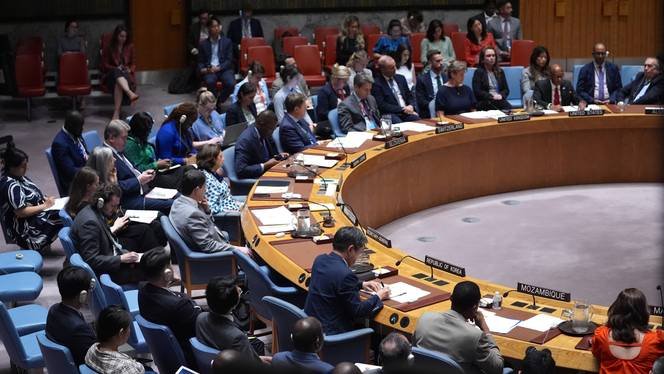

The Council held an emergency session on Wednesday in response to Haniyeh’s killing, following a request from Iran, with support from Russia, Algeria, and China.
During the session, Chinese Ambassador Fu Cong expressed China’s strong condemnation of Haniyeh’s assassination, calling it “a blatant attempt to sabotage peace efforts.” He voiced concerns about the potential for increased regional instability as a result of the incident.
Algeria’s UN envoy, Amar Bendjama, warned that the situation was “on the precipice of catastrophe,” labeling Israel’s action as “an act of terror” that violated both international law and Iran’s sovereignty.
Bendjama emphasized that this attack was not just against an individual but a direct assault on diplomatic relations, state sovereignty, and the principles of the global order. He condemned Israel’s aggressive policies and urged the international community to act, calling for an immediate and unconditional ceasefire in Gaza and the lifting of the Gaza blockade.
Echoing Algeria’s sentiments, Russia’s First Deputy Permanent Representative to the UN, Dmitry Polyansky, also condemned the assassination, warning that it posed “dangerous” consequences for the entire region.
He highlighted the attack’s detrimental impact on mediation efforts between Hamas and Israel, noting that Haniyeh was a key participant in ceasefire negotiations in the Gaza Strip. Polyansky criticized the practice of targeted assassinations, warning that it could push the Middle East toward a region-wide war.
He called for restraint and the full implementation of Security Council Resolution 1701, which includes the cessation of hostilities between Israel and Hezbollah and the disarmament of armed groups in Lebanon.
