

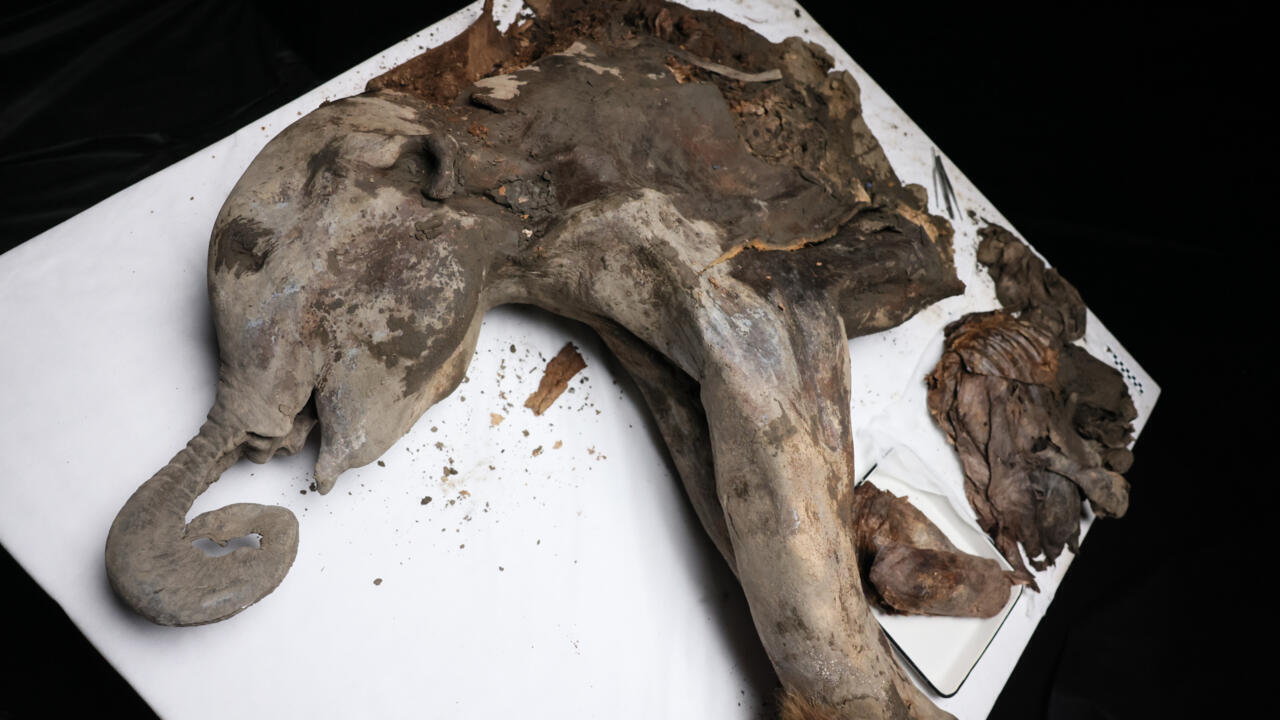

In an extraordinary scientific study, a 130,000-year-old baby mammoth named Yana is undergoing detailed examination in a laboratory in Russia’s far east. The mammoth, whose body was discovered last year in the Sakha region of Siberia, is offering researchers unprecedented insights into the ancient past, and potentially the future, as the thawing permafrost unveils more prehistoric creatures.
Yana’s remarkable preservation provides a rare opportunity for scientists to study not just her physical features but also the biological and environmental conditions of the time. The mammoth’s skin retains a greyish-brown color, and clumps of reddish fur are still visible. Her trunk, which curves towards her mouth, is intact, and her well-preserved eyes and sturdy legs closely resemble those of modern elephants.
Artemy Goncharov, head of the Laboratory of Functional Genomics and Proteomics of Microorganisms at the Institute of Experimental Medicine in Saint Petersburg, explained that this necropsy, which is essentially an autopsy for animals, allows researchers to delve into the Earth’s distant past. The team aims to identify ancient microorganisms and analyze the plants and spores Yana consumed, which may shed light on the region’s ancient ecosystem.
Yana’s preserved body offers a rare glimpse into the life of a mammoth. Measuring 1.2 meters (about four feet) at the shoulder, she weighed 180 kilograms (nearly 400 pounds). Her internal organs and soft tissues, including her stomach and intestines, have been preserved remarkably well, a feat made possible by the permafrost in which she was buried.
At the Mammoth Museum in Yakutsk, a group of six scientists conducted the necropsy, carefully extracting tissue samples for analysis. The discovery and preservation of Yana is attributed to the region’s permafrost, which has acted as a natural freezer for thousands of years, preserving the mammoth’s remains.
Yana, who was believed to have died around 50,000 years ago, is now confirmed to have perished more than 130,000 years ago, thanks to recent analysis. She was over a year old at the time of her death, as evidenced by the presence of her milk tusks, which are common among young elephants and mammoths.
The cause of Yana’s early death remains unknown. However, researchers note that during her lifetime, there were no humans in the area of modern-day Siberia, as human presence in the region occurred much later, between 28,000 and 32,000 years ago.
Yana’s discovery comes as scientists are increasingly concerned about the effects of global warming on the permafrost, which is rapidly thawing. Some researchers worry that this melting could release ancient, potentially harmful pathogens that were preserved in the ice. These microorganisms could find their way into the water supply, plants, animals, and even humans, posing a biological risk to modern ecosystems.
As the world faces the ongoing effects of climate change, Yana’s study provides valuable insights into both ancient life and the potential dangers of a warming planet.
